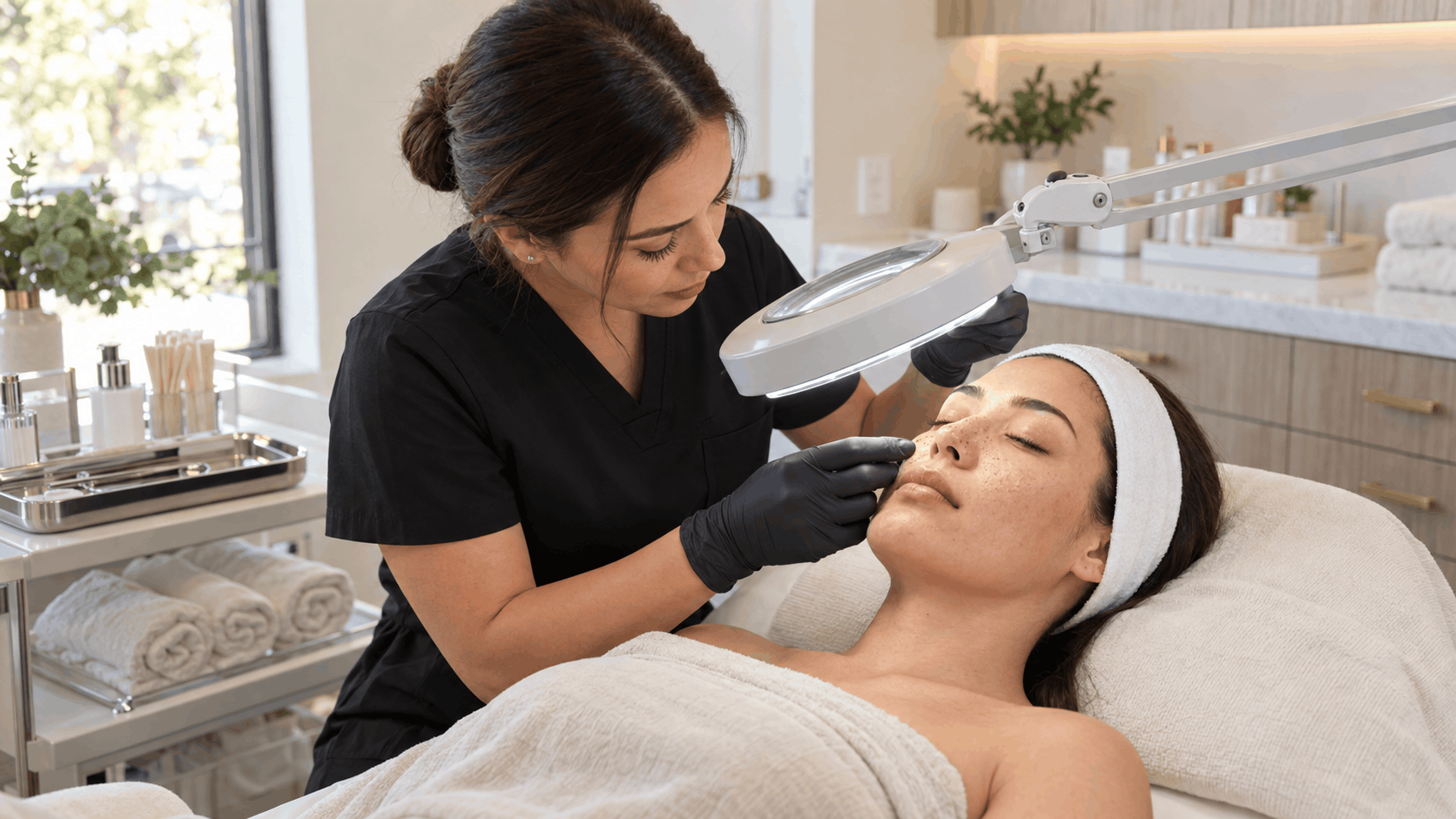
Clogged pores have a talent for showing up at the worst possible time. One day, your skin looks smooth; the next, you’re dealing with stubborn blackheads, tiny bumps, and a complexion that feels rough no matter how carefully you cleanse.
And while reaching for another exfoliating scrub might seem like the obvious solution, aggressive scrubbing can sometimes make matters worse.
That’s where a salicylic glycolic peel for clogged pores may come in.
This professional chemical peel combines two well-known exfoliating ingredients: salicylic acid and glycolic acid. Together, they can help address surface buildup, pore congestion, and uneven skin texture.
But how does the combination work, and is it actually better than using one exfoliating acid alone?
The biggest advantage is that salicylic acid and glycolic acid target different aspects of skin buildup. Salicylic acid is particularly useful for oily, congested pores, while glycolic acid helps exfoliate the skin’s surface.
Let’s break down the science, expected benefits, limitations, and what to consider before scheduling a treatment.
Jump To:
- Detailed Breakdown
- What Is a Salicylic/Glycolic Peel?
- How Does a Salicylic Glycolic Peel for Clogged Pores Work?
- What Skin Texture Problems Can This Peel Improve?
- Can a Salicylic Glycolic Peel Help With Acne?
- Can It Improve Dark Spots and Uneven Skin Tone?
- Salicylic Glycolic Peel vs. Microdermabrasion: Which Is Better?
- What Happens During a Salicylic/Glycolic Peel?
- How Many Treatments Are Needed for Clogged Pores?
- What Are the Possible Side Effects?
- How to Prepare for Your Peel
- How to Maintain Results After a Salicylic Glycolic Peel
- Key Takeaways
- FAQs
TL;DR – Quick Guide
- What it is: A professional chemical peel using salicylic acid, glycolic acid, or a combination of both.
- Main benefit: Helps exfoliate dead skin cells and improve the appearance of clogged pores and rough texture.
- Salicylic acid: An oil-soluble beta hydroxy acid commonly used for blackheads, whiteheads, and acne-prone skin.
- Glycolic acid: A water-soluble alpha hydroxy acid that helps remove surface buildup and improve skin smoothness.
- Best candidates: People with blackheads, mild comedonal acne, surface roughness, or dull-looking skin.
- Large pores: May make pores look less noticeable by reducing congestion, but cannot permanently shrink their natural size.
- Downtime: Depends on peel strength and skin sensitivity; redness, dryness, and visible peeling are possible.
- Results: Improvements vary, and multiple treatments or a consistent skincare routine may be needed.
Detailed Breakdown
What Is a Salicylic/Glycolic Peel?
A Salicylic/Glycolic Peel is a professional exfoliating treatment that uses salicylic acid and glycolic acid to address certain surface and pore-related skin concerns.
Both ingredients are chemical exfoliants, but they work differently.
Salicylic acid is a beta hydroxy acid (BHA), while glycolic acid is an alpha hydroxy acid (AHA).
Their complementary properties make them useful in skincare routines designed for congestion, uneven texture, and dullness.
However, not every salicylic/glycolic peel uses the same concentrations, pH, or application method.
Treatment strength, contact time, and the patient’s skin condition all influence the results and potential side effects.
For a broader explanation of exfoliating ingredients, explore Understanding Skincare Acids.
How Does a Salicylic Glycolic Peel for Clogged Pores Work?
To understand why this combination can be useful, it helps to know how pores become clogged.
Your skin naturally produces sebum, an oily substance that helps maintain its protective barrier.
At the same time, skin cells are continuously shed from the surface and from within hair follicles.
When oil and dead skin cells accumulate inside a follicle, they can form a comedone.
Open comedones are commonly called blackheads, while closed comedones are known as whiteheads.
A salicylic glycolic peel for clogged pores may help reduce this buildup through two complementary mechanisms.
Salicylic Acid: Targets Pore Congestion
Salicylic acid is oil-soluble, which makes it particularly useful in formulations intended for oily or acne-prone skin.
It helps loosen the bonds between accumulated skin cells and supports exfoliation within the follicular opening.
This may help improve:
- Blackheads.
- Whiteheads.
- Mild pore congestion.
- Roughness associated with clogged follicles.
- Some forms of mild acne.
However, salicylic acid isn’t a guaranteed solution for every type of acne.
Deep inflammatory acne or persistent breakouts may require additional medical treatment.
Glycolic Acid: Smooths the Skin’s Surface
Glycolic acid is a water-soluble alpha hydroxy acid derived from sugar cane.
It helps exfoliate surface skin cells, which can improve the appearance of roughness and dullness.
Potential benefits include:
- Smoother-looking skin.
- Reduced surface buildup.
- Improved appearance of uneven texture.
- Brighter-looking complexion.
- Gradual improvement in some superficial discoloration.
The U.S. Food and Drug Administration notes that alpha hydroxy acids can increase skin sensitivity to ultraviolet radiation, making sun protection especially important.
Why Combining Them Can Be Useful
Think of salicylic acid as the ingredient that focuses on congestion and glycolic acid as the ingredient that focuses on surface texture.
Used appropriately, the combination may address both concerns during one treatment.
That doesn’t mean a combined peel is automatically stronger, safer, or more effective than a single-acid peel.
The best formulation depends on your skin type, sensitivity, and treatment goals.
What Skin Texture Problems Can This Peel Improve?
A salicylic glycolic peel for clogged pores may be considered for several common cosmetic concerns.
1. Blackheads and Whiteheads
Blackheads and whiteheads develop when oil and skin cells accumulate inside follicles.
Chemical exfoliation can help reduce the buildup that contributes to these clogged pores.
However, stubborn congestion may require a consistent skincare routine or additional professional care.
2. Rough, Bumpy Skin
Small bumps can make your complexion feel uneven, even when your skin doesn’t look particularly inflamed.
Exfoliating acids may help improve surface smoothness by reducing accumulated dead skin cells.
It’s important to identify the cause of the bumps, though, because not every raised spot is a clogged pore.
3. Dull-Looking Skin
Surface buildup can contribute to a lackluster complexion.
Glycolic acid may help reveal a brighter-looking surface by encouraging exfoliation.
The result is usually cosmetic and gradual rather than a permanent transformation.
4. The Appearance of Large Pores
Pores can appear more noticeable when they’re filled with oil and debris.
Reducing congestion may make them look less prominent.
However, pore size is influenced by genetics, skin structure, oil production, and aging.
A chemical peel cannot permanently erase pores or change their natural anatomy.
If enlarged pores are your main concern, explore Large Pores for additional treatment considerations.
Can a Salicylic Glycolic Peel Help With Acne?
Yes, it may help certain types of acne, particularly mild comedonal acne involving blackheads and whiteheads.
Salicylic acid is commonly used in acne care because of its exfoliating properties.
Glycolic acid may help improve surface texture and the appearance of some post-acne discoloration.
However, chemical peels aren’t always the first or only treatment needed.
Persistent inflammatory acne, painful cysts, or acne that causes scarring may require a dermatologist’s assessment.
Explore Genesis MedSpa’s Acne & Acne Scars information to learn about the different concerns that can occur after breakouts.
Important distinction: Improving clogged pores is not the same as treating deep acne scars.
Indented scars involve changes in the skin’s supporting structures and often require different procedures.
Can It Improve Dark Spots and Uneven Skin Tone?
Some people experience lingering dark marks after acne clears.
These marks may be caused by post-inflammatory hyperpigmentation, or PIH.
Glycolic acid and other exfoliating treatments may help improve certain superficial pigmentation concerns over time.
However, results depend on pigment depth, skin tone, and the treatment protocol.
Excessive irritation can actually worsen pigmentation, especially in skin prone to PIH.
For more information, explore Uneven Skin Tone & Hyperpigmentation.
A qualified provider can help determine whether a salicylic glycolic peel for clogged pores is suitable when pigmentation is also a concern.
Salicylic Glycolic Peel vs. Microdermabrasion: Which Is Better?
Both treatments are used to improve skin texture, but they work differently.
Microdermabrasion uses mechanical exfoliation to remove surface skin cells.
A salicylic/glycolic peel uses chemical exfoliating ingredients.
| Feature | Salicylic/Glycolic Peel | Microdermabrasion |
| Exfoliation method | Chemical acids | Mechanical exfoliation |
| Main focus | Pore congestion and surface texture | Surface roughness and dullness |
| Blackheads | May help reduce follicular buildup | May improve some superficial congestion |
| Uneven skin tone | May improve selected superficial discoloration | May provide modest cosmetic improvement |
| Sensitivity concerns | Depends on acid strength and skin condition | Depends on device settings and skin condition |
| Recovery | Varies by peel depth | Usually limited for gentle treatments |
If blackheads and congestion are your primary concerns, a salicylic-acid-based treatment may be particularly relevant.
If surface roughness is the main issue, microdermabrasion may be another option.
For a closer comparison, read Microdermabrasion for Clogged Pores.
What Happens During a Salicylic/Glycolic Peel?
The exact treatment process depends on the formulation and provider’s protocol.
A typical appointment may involve several steps.
Step 1: Skin Assessment
Your provider evaluates your skin, current concerns, and relevant medical history.
They may ask about medications, recent treatments, allergies, and previous reactions to exfoliating products.
Step 2: Cleansing
The skin is cleansed to remove makeup, oil, and surface impurities.
This prepares the treatment area for the peel.
Step 3: Peel Application
The exfoliating solution is applied according to the specific product protocol.
You may experience temporary tingling, warmth, or stinging.
The provider monitors your skin and determines when the treatment should end.
Step 4: Removal or Neutralization
Depending on the formulation, the peel may be removed or neutralized according to manufacturer instructions.
Not all chemical peels require the same neutralization process.
Step 5: Aftercare
The provider may apply soothing products, moisturizer, and sun protection.
You’ll receive instructions about which skincare ingredients to avoid during recovery.
For a broader overview, read Chemical Peels Explained: Choosing the Right One for Your Skin.
How Many Treatments Are Needed for Clogged Pores?
One of the most common questions about a salicylic glycolic peel for clogged pores is how quickly results appear.
Some people may notice smoother-looking skin after one treatment.
However, persistent congestion often requires ongoing skincare and sometimes a series of professional treatments.
The appropriate schedule depends on:
- Severity of pore congestion.
- Skin sensitivity.
- Acne activity.
- Peel concentration and depth.
- Previous treatment response.
- Home skincare products.
- Risk of post-inflammatory hyperpigmentation.
There is no universal number of treatments that guarantees clear pores.
A provider should recommend an individualized plan rather than automatically scheduling frequent peels.
What Are the Possible Side Effects?
Chemical peels can cause temporary reactions, including:
- Redness.
- Dryness.
- Tightness.
- Stinging.
- Flaking or peeling.
- Increased sensitivity.
Less common but more serious complications can include burns, infection, scarring, and changes in pigmentation.
People with darker skin tones or a history of post-inflammatory hyperpigmentation may need additional precautions.
The American Academy of Dermatology explains that chemical peel results and recovery depend on the type and depth of treatment.
A stronger peel isn’t automatically a better peel.
Choosing the appropriate formulation and treatment intensity is essential.
How to Prepare for Your Peel
Before your appointment, follow your provider’s instructions carefully.
General preparation may include:
- Avoiding unnecessary exfoliation: Don’t combine multiple harsh scrubs or acid products before treatment.
- Reviewing medications: Tell your provider about retinoids, isotretinoin, and other acne medications.
- Protecting your skin from the sun: Sunburned or irritated skin may require postponement.
- Avoiding new skincare experiments: Introduce unfamiliar products well before your appointment.
- Discussing your skin history: Mention eczema, rosacea, allergies, and previous pigmentation problems.
Do not stop prescription medications without guidance from the prescribing clinician.
How to Maintain Results After a Salicylic Glycolic Peel
A professional peel can support smoother-looking skin, but your daily routine matters.
To help maintain results:
- Use a gentle cleanser.
- Apply a suitable moisturizer.
- Wear broad-spectrum sunscreen with SPF 30 or higher.
- Avoid picking or squeezing blackheads.
- Reintroduce exfoliating ingredients only when your provider advises.
- Avoid layering multiple strong acids without professional guidance.
- Follow a consistent acne-care plan when needed.
If your pores repeatedly become clogged, your provider may recommend appropriate at-home products or additional treatment options.
You can explore the available Facials & Lasers Services to learn about other professional skincare approaches.
Key Takeaways
- A salicylic glycolic peel for clogged pores combines complementary exfoliating ingredients: Salicylic acid focuses on follicular congestion, while glycolic acid helps improve surface texture.
- It may improve blackheads and whiteheads: Chemical exfoliation can help reduce buildup that contributes to comedonal acne.
- Skin texture may look smoother: Removing surface buildup can improve roughness and dullness.
- Pores won’t disappear: Reducing congestion may make pores less noticeable, but their natural size cannot be permanently eliminated.
- Some discoloration may improve: Superficial post-acne pigmentation may respond, although results vary.
- Treatment strength matters: Concentration, formulation, and skin sensitivity influence both effectiveness and recovery.
- Aftercare is essential: Gentle skincare and consistent sun protection help reduce unnecessary irritation.
- Professional guidance improves treatment selection: A qualified provider can determine whether a chemical peel, microdermabrasion, or another treatment best fits your skin.
Wondering whether a salicylic glycolic peel is right for your clogged pores?
At Genesis MedSpa, you can explore professional exfoliating treatments and discuss your skin texture concerns with a qualified provider.
A personalized consultation can help identify what’s causing your congestion and determine whether this peel is appropriate for your skin.
Because smoother skin isn’t about scrubbing harder—it’s about choosing the right treatment.
FAQs
1. Is a salicylic glycolic peel good for clogged pores?
A salicylic glycolic peel for clogged pores may help reduce buildup associated with blackheads and whiteheads. Salicylic acid targets pore congestion, while glycolic acid helps exfoliate surface skin cells. Results depend on the formulation, severity of congestion, and individual skin response.
2. Can a salicylic glycolic peel permanently shrink pores?
A salicylic glycolic peel cannot permanently change the natural size of your pores. However, reducing oil and dead skin cell buildup may make enlarged pores appear less noticeable. Maintaining results often requires consistent skincare and appropriate treatment of ongoing congestion.
3. How many salicylic glycolic peels do I need to see results?
Some people may notice improved surface smoothness after one treatment. Persistent blackheads, whiteheads, or uneven texture may require additional sessions and ongoing skincare. Your provider should determine the treatment schedule based on your skin condition and response.
4. Is a salicylic glycolic peel better than microdermabrasion for blackheads?
Salicylic-acid-based treatments may be particularly useful for blackheads because salicylic acid helps address follicular buildup. Microdermabrasion primarily exfoliates the skin’s surface and may be more suitable for certain roughness concerns. The best option depends on your skin type, sensitivity, and the cause of your congestion.
5. Can I use salicylic acid or glycolic acid at home after a professional peel?
You should avoid restarting strong exfoliating products until your provider confirms that your skin has recovered sufficiently. Using multiple acids too soon after a peel may increase irritation and the risk of pigmentation changes. Follow your personalized aftercare instructions before reintroducing active skincare ingredients.