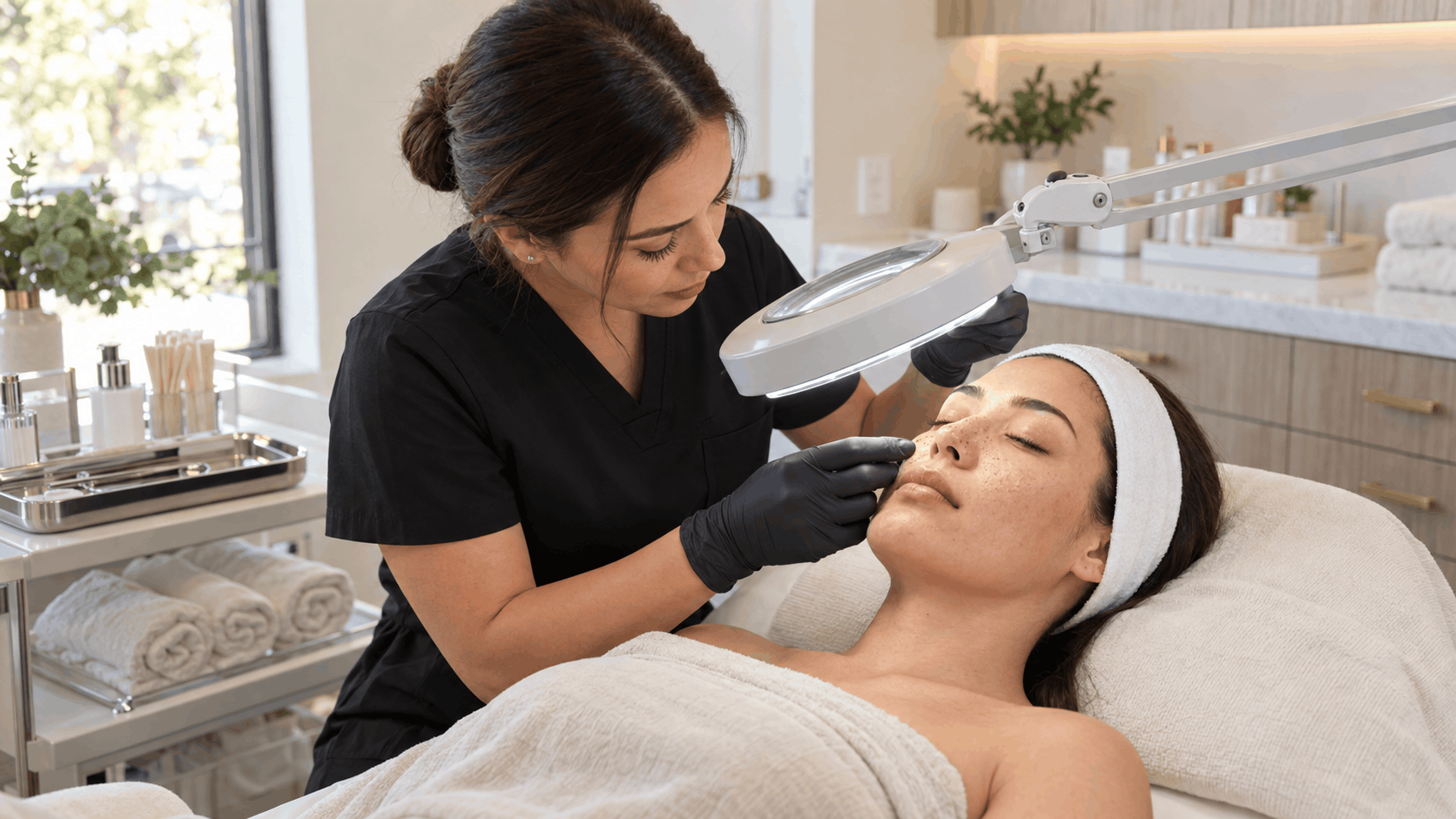
You notice a faint line across your forehead. Your skin looks a little duller than it did last year. And suddenly, you’re wondering whether it’s time to upgrade your skincare routine or explore professional anti-aging treatments.
Sound familiar?
When comparing Forever Young Facial vs Botox, the biggest difference isn’t which treatment makes you look younger. It’s how each treatment addresses the early signs of aging.
A Forever Young Facial focuses on improving the appearance and condition of your skin, while Botox targets specific facial muscles responsible for expression-related wrinkles.
Both can have a place in a thoughtful skincare plan, but they aren’t interchangeable.
The right choice depends on whether your biggest concern is skin quality, facial expression lines, or a combination of both.
Let’s explore how these treatments compare, what results you can realistically expect, and how to decide which approach makes sense for your skin.
Jump To:
- TL;DR – Quick Guide
- Detailed Breakdown
- What Is a Forever Young Facial?
- What Is Botox and How Does It Work?
- Forever Young Facial vs Botox: Side-by-Side Comparison
- Which Treatment Is Better for Fine Lines and Wrinkles?
- Which Is Better for Dull or Tired-Looking Skin?
- Can a Forever Young Facial Prevent Wrinkles?
- What About Preventative Botox?
- How Quickly Will You See Results?
- Which Treatment Has Less Downtime?
- Can You Get a Forever Young Facial and Botox Together?
- What About Botox vs. Other Neurotoxins?
- How Much Do Forever Young Facials and Botox Cost?
- How to Choose Between Forever Young Facial vs Botox
- Questions to Ask Before Booking
- Key Takeaways
- FAQs
TL;DR – Quick Guide
- Forever Young Facial: A professional facial treatment intended to support smoother, healthier-looking, more radiant skin.
- Botox: An injectable neuromodulator that temporarily relaxes selected muscles responsible for certain expression lines.
- Best for dullness: A Forever Young Facial may be more relevant for lackluster-looking skin and surface texture concerns.
- Best for expression lines: Botox is generally more effective for targeted dynamic wrinkles, such as frown lines.
- Results timeline: Facial results may be noticeable soon after treatment, while Botox typically develops over several days.
- Longevity: Facial benefits vary by treatment protocol and skincare habits; Botox cosmetic effects commonly last around 3–4 months.
- Downtime: Both may involve temporary side effects, but Botox requires additional injection-specific precautions.
- Best overall approach: Choose based on your primary concern, skin condition, and medical suitability.
Detailed Breakdown
What Is a Forever Young Facial?
A Forever Young Facial is a professional facial treatment offered by Genesis MedSpa for clients interested in maintaining a refreshed, youthful-looking complexion.
Unlike injectable wrinkle treatments, a facial generally focuses on the skin’s surface condition.
Depending on the specific treatment protocol, professional facials may address concerns such as:
- Dull-looking skin.
- Dryness and dehydration.
- Uneven surface texture.
- Temporary lack of radiance.
- The appearance of fine surface lines.
The exact products, techniques, and treatment steps used in a Forever Young Facial should be confirmed with your provider.
Important: A facial cannot be assumed to relax facial muscles or provide the same wrinkle-reduction effects as Botox.
Its benefits are primarily related to skin appearance and care rather than altering muscle movement.
What Is Botox and How Does It Work?
Botox is an injectable prescription medication containing botulinum toxin type A.
When administered by an appropriately trained medical professional, Botox temporarily reduces activity in selected facial muscles.
This can soften the appearance of certain dynamic wrinkles.
Dynamic wrinkles develop from repeated facial expressions, including:
- Frowning.
- Squinting.
- Raising your eyebrows.
- Smiling.
Over time, repeated muscle movements can contribute to lines that become visible even when your face is relaxed.
Botox works by temporarily reducing the muscle activity responsible for selected expression lines.
It does not exfoliate the skin, remove dead skin cells, or directly improve skin hydration.
For more information about injectable wrinkle treatments, explore Genesis MedSpa’s Neurotoxins services.
Forever Young Facial vs Botox: Side-by-Side Comparison
Here’s how the two treatments compare.
| Feature | Forever Young Facial | Botox |
| Primary goal | Improve skin appearance and radiance | Reduce selected expression-related wrinkles |
| Treatment type | Professional facial | Prescription injectable |
| Main target | Skin surface and overall complexion | Targeted facial muscles |
| Best for | Dullness, surface texture, general skin maintenance | Frown lines and other suitable dynamic wrinkles |
| Immediate results | Skin may look refreshed soon afterward | Results develop gradually |
| Typical longevity | Varies with treatment and skincare routine | Often around 3–4 months |
| Needles required | Generally no | Yes |
| Potential side effects | Temporary redness or irritation | Bruising, swelling, headache, and other injection-related risks |
| Maintenance | Based on skin goals and treatment protocol | Repeat treatment may be needed as effects wear off |
The key takeaway?
A facial improves the canvas. Botox addresses certain lines created by movement.
Neither treatment should be considered universally better.
Which Treatment Is Better for Fine Lines and Wrinkles?
When comparing Forever Young Facial vs Botox for wrinkles, it’s important to distinguish between different types of lines.
Dynamic Wrinkles: Botox Has the Advantage
Dynamic wrinkles are most noticeable when you make facial expressions.
Examples include:
- Horizontal forehead lines.
- Vertical frown lines between the eyebrows.
- Crow’s feet around the eyes.
Botox may help soften these lines by temporarily reducing the activity of the muscles involved.
However, the appropriate injection sites and treatment areas depend on the product’s approved indications, individual anatomy, and professional assessment.
Fine Surface Lines: A Facial May Help Their Appearance
Some fine lines become more noticeable when skin is dry, dehydrated, or lacking surface smoothness.
Professional facial treatments may temporarily improve the appearance of these lines by supporting hydration and skin conditioning.
However, deeper wrinkles and persistent expression lines usually require a different approach.
For more information about different wrinkle concerns, explore Fine Lines & Wrinkles.
Which Is Better for Dull or Tired-Looking Skin?
If your biggest concern is a complexion that looks tired, flat, or lacking in radiance, a Forever Young Facial may be the more relevant starting point.
Dull-looking skin can be influenced by:
- Surface buildup.
- Dryness.
- Environmental exposure.
- Inconsistent skincare.
- Changes in skin texture.
- Natural aging.
Professional facials may help improve the appearance of surface smoothness and hydration.
Botox, by comparison, doesn’t directly remove dead skin cells or brighten the complexion.
It may soften certain expression lines, but it isn’t a substitute for skin-focused treatments.
If your complexion needs more attention than your forehead lines, explore Genesis MedSpa’s Dull Skin information.
Can a Forever Young Facial Prevent Wrinkles?
A common question in the Forever Young Facial vs Botox discussion is whether regular facials can prevent visible aging.
The answer requires realistic expectations.
Facials can support a consistent skincare routine and may temporarily improve hydration, texture, and radiance.
However, there is limited evidence that a specific facial can permanently prevent wrinkles.
Skin aging is influenced by several factors, including:
- Genetics.
- Sun exposure.
- Smoking.
- Environmental conditions.
- Facial movement.
- Natural changes in collagen and elastin.
The most important long-term habits include daily sun protection, appropriate skincare, and avoiding unnecessary skin irritation.
Professional facials may complement those habits, but they cannot stop the natural aging process.
What About Preventative Botox?
Preventative Botox refers to using neuromodulator injections before certain expression lines become deeply established.
The idea is that reducing repeated muscle movement may help limit the development of some dynamic wrinkles.
However, preventative Botox is not necessary for everyone.
There is no universal age when people should begin treatment.
A person in their twenties with minimal expression lines may have different needs from someone in their thirties or forties with more noticeable muscle-related wrinkles.
Factors to consider include:
- The type and severity of expression lines.
- Facial anatomy and muscle activity.
- Personal aesthetic goals.
- Medical history and contraindications.
- Willingness to maintain repeat treatments.
If you’re curious about early intervention, read Preventative Botox.
Starting earlier isn’t automatically better. Treatment should be based on individual needs, not a birthday.
How Quickly Will You See Results?
Timing matters, especially if you’re preparing for a wedding, vacation, reunion, or professional event.
Forever Young Facial Results
Depending on the treatment protocol, skin may appear smoother, more hydrated, or refreshed shortly after a facial.
Some clients may experience temporary redness or sensitivity.
The duration of visible benefits depends on the products used, skin condition, and ongoing skincare routine.
Botox Results
Botox doesn’t typically produce its full cosmetic effect immediately.
Early changes may appear within several days, with the full effect often assessed around two weeks after treatment.
The results gradually wear off as muscle activity returns.
For cosmetic indications, effects commonly last approximately three to four months, although individual experiences vary.
If you’re preparing for an important event, allow enough time for results to develop and for any temporary side effects to resolve.
Which Treatment Has Less Downtime?
Both treatments are commonly performed without extensive recovery periods, but that doesn’t mean they’re risk-free.
After a Forever Young Facial
Depending on the treatment steps, you may experience:
- Temporary redness.
- Mild sensitivity.
- Tightness.
- Dryness.
- Occasional irritation.
More intensive exfoliating components may require additional aftercare.
Your provider should explain what to expect based on the specific facial being performed.
After Botox
Possible temporary effects include:
- Redness at injection sites.
- Minor swelling.
- Bruising.
- Tenderness.
- Headache.
More serious complications are uncommon but possible.
Botulinum toxin products carry important safety warnings, including the potential for toxin effects to spread beyond the injection area.
Seek urgent medical attention if symptoms such as difficulty swallowing, speaking, or breathing occur after treatment.
Botox should only be administered by an appropriately qualified healthcare professional.
Can You Get a Forever Young Facial and Botox Together?
For some clients, combining skin-focused treatments with injectable wrinkle reduction may be appropriate.
The reasoning is simple: the two approaches address different concerns.
A facial may help improve skin appearance, while Botox can soften selected expression lines.
However, treatment timing matters.
Massage, pressure, exfoliation, and certain facial procedures may not be appropriate immediately after Botox injections.
Your provider should recommend a safe interval between treatments based on the facial protocol and your injection plan.
Don’t assume that two treatments are automatically better than one.
A combined approach should be recommended because it addresses your goals—not because it fills a package.
What About Botox vs. Other Neurotoxins?
Botox isn’t the only injectable neuromodulator used for cosmetic wrinkle reduction.
Other products, including Dysport, may be considered for suitable patients.
These medications share a general mechanism of temporarily reducing targeted muscle activity, but they aren’t identical or directly interchangeable.
Differences can include:
- Product formulation.
- Dosing units.
- Approved indications.
- Injection technique.
- Individual response.
If you’re comparing injectable options, read Dysport vs Botox: Natural-Looking Wrinkle Reduction.
A qualified injector can explain which product may be appropriate for your treatment goals.
How Much Do Forever Young Facials and Botox Cost?
Cost is another factor when deciding between Forever Young Facial vs Botox.
A professional facial is generally priced by the service, while Botox is often priced according to units used or treatment areas.
However, pricing structures vary by provider.
The total cost may depend on:
- Treatment area.
- Individual anatomy.
- Recommended dosage.
- Facial protocol.
- Number of appointments.
- Maintenance frequency.
- Additional services.
Rather than comparing only the price of one appointment, consider the longer-term maintenance commitment.
A lower initial price doesn’t necessarily mean a lower annual cost.
Ask Genesis MedSpa for current pricing and a personalized treatment estimate before booking.
How to Choose Between Forever Young Facial vs Botox
Still unsure which treatment makes the most sense?
Start by identifying your biggest concern.
Consider a Forever Young Facial If:
- Your skin looks dull or tired.
- You want to improve surface smoothness.
- Your main concern is skin hydration or radiance.
- You prefer a non-injectable treatment.
- You’re interested in professional skincare maintenance.
Consider a Botox Consultation If:
- You notice expression lines when frowning or raising your eyebrows.
- You’re concerned about specific dynamic wrinkles.
- You’re comfortable with injectable treatments.
- You understand that results are temporary.
- You’re willing to discuss medical suitability and potential risks.
Consider a Broader Anti-Aging Consultation If:
- You have both dull skin and expression lines.
- You’re unsure whether your wrinkles are dynamic or static.
- You want a personalized treatment plan.
- You’re considering several different options.
- You want realistic expectations before committing.
You can explore Anti-Aging Facials in Colorado Springs for more information about skin-focused rejuvenation.
Genesis MedSpa also offers a broader selection of Facials & Lasers Services for different cosmetic concerns.
Questions to Ask Before Booking
Before scheduling a Forever Young Facial or Botox appointment, consider asking:
- What is causing my main concern? Is it dryness, surface texture, muscle movement, or something else?
- What results are realistic? Ask which changes are likely and which concerns the treatment cannot address.
- How long will the results last? Understand the expected maintenance schedule.
- What side effects should I expect? Discuss both common reactions and important risks.
- Can I combine treatments safely? Ask about appropriate spacing between services.
- What will the full plan cost? Request pricing that includes expected follow-up appointments.
Clear answers help you make a confident decision without chasing unnecessary treatments.
Key Takeaways
- Forever Young Facial vs Botox isn’t a direct competition: These treatments address different aspects of facial aging.
- Forever Young Facial focuses on skin appearance: It may help improve dullness, surface smoothness, and overall radiance.
- Botox targets expression-related wrinkles: It temporarily reduces activity in selected facial muscles.
- Fine lines have different causes: Dehydration-related lines and dynamic wrinkles may require different approaches.
- Results develop differently: Facial benefits may be noticeable sooner, while Botox typically takes several days to develop.
- Neither treatment stops aging: Both offer cosmetic improvements rather than permanent prevention.
- Combining treatments may be useful: Some clients benefit from addressing skin quality and muscle-related wrinkles separately.
- Professional guidance matters: Treatment decisions should reflect your goals, skin condition, anatomy, and medical history.
Wondering whether a Forever Young Facial or Botox is the better starting point?
At Genesis MedSpa, you can explore professional skincare treatments and injectable options tailored to different signs of aging.
A personalized consultation can help determine whether your concerns are best addressed through facial care, wrinkle-relaxing injections, or a carefully planned combination.
Because looking refreshed isn’t about doing everything—it’s about choosing what actually works for your skin.
FAQs
1. Is a Forever Young Facial better than Botox for early signs of aging?
A Forever Young Facial may be more appropriate for dullness, surface roughness, and general skin maintenance. Botox is typically more effective for selected expression-related wrinkles caused by facial muscle movement. The better choice depends on which signs of aging concern you most.
2. Can a Forever Young Facial replace Botox?
A Forever Young Facial cannot reproduce Botox’s muscle-relaxing effects. It may improve the appearance of skin texture and radiance, but it won’t directly target the muscle activity responsible for dynamic wrinkles. Some people may benefit from both approaches when medically appropriate.
3. How long do Forever Young Facial vs Botox results last?
The visible benefits of a Forever Young Facial vary depending on the treatment protocol, skin condition, and home skincare routine. Botox cosmetic effects commonly last around three to four months, although individual results vary. Your provider can explain the expected maintenance schedule for each treatment.
4. Is Botox necessary in your twenties or thirties?
Botox isn’t automatically necessary at any particular age. Treatment decisions should depend on expression lines, facial anatomy, personal goals, and medical suitability rather than age alone. Many people can focus on sun protection and consistent skincare without needing injections.
5. Can I get Botox and a Forever Young Facial during the same week?
The appropriate timing depends on the specific facial procedures involved and your Botox treatment plan. Some facial techniques may need to be avoided for a period after injections to reduce unnecessary pressure or irritation. Ask your provider to recommend a safe schedule before combining appointments.